Key Takeaways
- Force plates measure six objective metrics an ACL knee has to pass before return-to-sport, not just "does it feel ready."
- Limb symmetry below 90% on jump and landing tasks predicts a higher reinjury rate per multiple 2024-2025 studies.
- Force absorption is more predictive of reinjury than jump height for ACL-reconstructed athletes.
- Every True Sports clinic now has force plates, with the Frederick clinic's most recent education session led directly by a Hawkins Dynamics rep.
- Time-based clearance (e.g., "you're cleared at 9 months") is not a real return-to-sport criterion; objective testing is.
- Reactive strength index (RSI) gives a single-number readout of how quickly an athlete can absorb and re-express force, which translates directly to cutting and pivoting sports.
Force plate testing for ACL return-to-sport measures six specific things your knee has to demonstrate before the sport asks for it the first time: limb-to-limb asymmetry, jump height, force production, force absorption, speed, and reactive strength. Standard return-to-sport testing has historically leaned on hop tests and a clinician's eye, both of which miss subtle deficits that show up as reinjury six months later. The numbers you get off a force plate are what separate "feels ready" from "is ready." At True Sports, every clinic now runs force plate testing as part of our ACL rehab protocol, and at our Frederick clinic we recently brought in Hawkins Dynamics directly to train our team on the system. This guide walks through what each metric actually measures, why limb symmetry below 90% is a real warning sign, and how the data shapes the day-to-day rehab plan.
What Does Force Plate Testing Actually Measure?
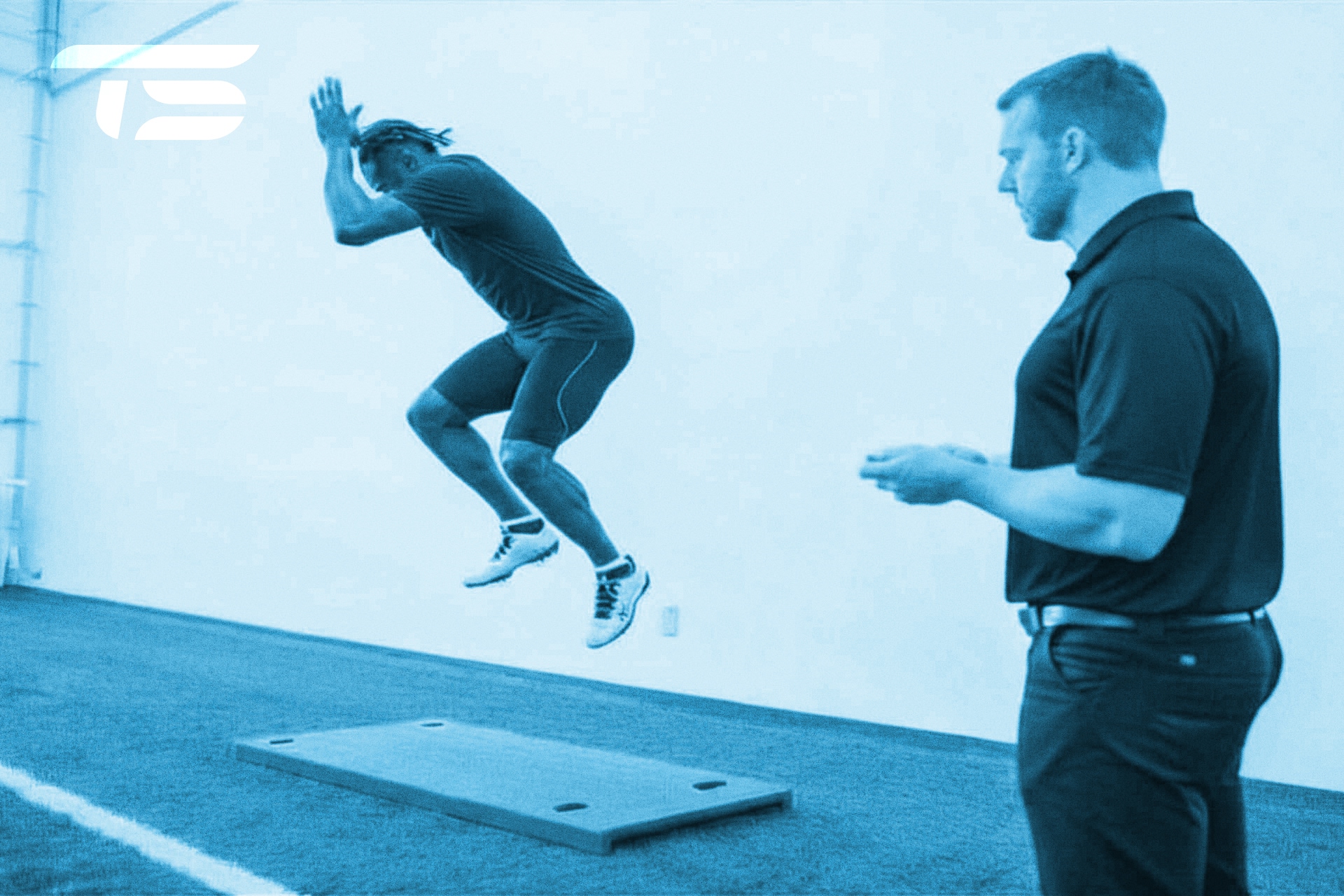
Force plate testing for ACL return-to-sport measures six objective metrics through ground reaction force: limb-to-limb asymmetry, jump height, force production, force absorption, speed, and reactive strength. Each one represents a different demand your sport will place on the reconstructed knee. The combined readout gives an evidence-based picture no eyeball assessment can match.
The six metrics, expanded:
- Limb-to-limb asymmetry: how much harder the uninvolved leg works than the surgical leg during a bilateral jump.
- Jump height: vertical displacement during a countermovement jump.
- Force production: the peak force generated during the concentric (push-off) phase.
- Force absorption: the peak force absorbed during the eccentric (landing) phase.
- Speed: how quickly force is produced or absorbed (rate of force development).
- Reactive strength: the ratio of jump height to ground contact time during a drop jump, expressed as the reactive strength index.
A 2025 AOSSM RTS review notes that integrating force plate metrics with traditional hop testing and strength testing produces a more complete return-to-sport profile than any single test in isolation. As we see in clinic at Frederick, athletes who pass a hop test by visual inspection often still show a 12-15% asymmetry in eccentric force absorption on the plates. That deficit is exactly where late-stage rehab work needs to live.
Why Is Limb Symmetry Below 90% a Warning Sign?
Limb symmetry below 90% on jump and landing tasks is one of the strongest predictors of ACL reinjury after surgical reconstruction. Multiple 2024-2025 studies cited in the AOSSM RTS integration paper and the Sparta Science reliability study treat 90% limb symmetry as the minimum threshold for clearance.
The underlying reason is mechanical. If your surgical leg only produces 80% of the force your healthy leg produces, every landing, cut, and change of direction transfers more load onto the uninvolved knee. The surgical knee absorbs the rest at a rate it cannot yet handle. Per the AOSSM 2024 review, reinjury rates climb steeply when athletes return with sub-90% symmetry, especially in pivoting sports like soccer, lacrosse, and basketball.
Dr. TJ Holdredge, PT, DPT, CSCS, FRCms at our Frederick clinic notes:
"The eye-test almost always overstates how ready the surgical leg is. A patient who looks symmetric on a single-leg hop test can show 15% deficits on the force plate during the absorption phase of a drop jump. That's where the reinjury risk lives, and that's exactly what the plates catch."
This is why our protocol uses 90% symmetry across multiple force plate tests, not just a single jump, as one of the gating criteria before clearance.
What's the Difference Between Force Production and Force Absorption?
Force production is what your knee generates during a push-off (jumping up, accelerating, exploding into a sprint). Force absorption is what your knee receives during a landing or deceleration. For ACL-reconstructed athletes, force absorption is often more predictive of reinjury than force production, because most non-contact ACL tears happen during landing or cutting, not during the push-off.
A drop jump from a 30-cm box illustrates this well. The athlete steps off the box, lands, then immediately jumps as high as possible. The force plate captures both phases:
- The landing peak is the eccentric force absorption, measured in body weights, often 4-6x BW for a healthy athlete.
- The push-off peak is the concentric force production, typically 2-3x BW.
- The ratio between landing time and jump height gives the reactive strength index.
Per the AOSSM RTS asymmetry paper, surgical legs frequently show normal force production but reduced force absorption months after rehab is "complete" by traditional metrics. This is why we structure late-stage ACL rehab around progressive landing tasks, plyometric depth jumps, and bilateral-to-unilateral progressions: each one drives the absorption side back toward symmetry.
How Does Force Plate Data Change the Rehab Plan?
Force plate data lets the rehab plan target deficits objectively rather than chasing what feels weak. When the plates show 85% symmetry in jump height but 78% in force absorption, the late-stage program shifts toward eccentric loading, drop jumps, and unilateral landings rather than another month of generic strengthening.
Specific patterns that change our day-to-day approach:
- Sub-85% symmetry on concentric force production → progressive heavy resistance training with single-leg variants (Bulgarian splits, single-leg press, step-ups with 80%+ 1RM).
- Sub-85% symmetry on eccentric force absorption → drop landings from progressively higher boxes, single-leg countermovement jumps, deceleration drills.
- Low reactive strength index (RSI under 1.5) → contact-time-focused plyometric work (pogo jumps, fast hops) to teach the knee to absorb and re-express force quickly.
The integration matters because, as the AOSSM review notes, no single test is sufficient. A 95% symmetric athlete on a hop test who has poor RSI is still at higher reinjury risk in cutting sports because they cannot absorb and redirect force fast enough at game speed. The plates tell us when that gap exists.
This is the kind of late-stage work covered in our Strength and Conditioning service line, often paired with BFR rehab when the surgical leg needs muscle volume catch-up without high external load.
Time-Based Clearance vs Criterion-Based Clearance
Time-based clearance ("you're cleared at 9 months") is not a real return-to-sport criterion. A 2025 AOSSM-aligned position makes clear that time post-surgery is necessary but not sufficient. Biology needs the time, but the knee also has to demonstrate the capacity. Force plate testing is one of several objective measures (alongside isokinetic strength, hop testing, and psychological readiness assessment) that together form the gating criteria.
At True Sports, criterion-based clearance means an athlete must demonstrate:
- ≥90% limb symmetry across the force plate metric panel
- ≥90% quadriceps strength symmetry on isokinetic testing
- Successful single-leg hop test battery
- Functional movement screen clean on cutting and decel tasks
- ACL-RSI psychological readiness score above the published cutoff
A 7-month post-op athlete who clears all five is more ready than a 12-month post-op athlete who clears only three. The time horizon and the criteria work together, not separately.
Nutrition for Tendon and Tissue Repair During Late-Stage ACL Rehab
Late-stage ACL rehab is when force plate metrics are climbing and the surgical leg is being asked to load aggressively. Nutrition supports that load. Collagen at 10 grams daily taken with vitamin C 30-60 minutes before resistance training has been shown to support tendon and ligament adaptation through increased glycine and proline availability at the time of mechanical load. Protein at 1.6 to 2.2 grams per kilogram of bodyweight daily, distributed across 20-40g doses per meal, supports the muscle protein synthesis needed to rebuild the quad and glute on the surgical side. Spreading protein evenly across the day matters more than the total alone. A single 80g dinner is less effective for adaptation than four 30g doses. Omega-3s at 1,000 to 2,000mg combined EPA and DHA support the inflammation-resolution side of tissue remodeling, which becomes relevant as eccentric loading volumes climb.
Bottom Line
- Force plates measure six objective ACL return-to-sport metrics that visual inspection and time-based clearance cannot.
- Limb symmetry below 90% on the plates is a real reinjury predictor, especially in eccentric force absorption.
- At True Sports, every clinic now runs force plate testing as part of our ACL rehab protocol. Book your evaluation at our booking page.
Frequently Asked Questions
How long after ACL surgery can I start force plate testing? Most athletes begin force plate testing at the 4-6 month mark, once initial strength benchmarks (typically 70% quad symmetry on isokinetic testing) are met. The plates are not used in early rehab because the tasks (jumps, drop landings) require a baseline level of strength and graft healing.
Do all True Sports clinics have force plates? Yes. Every True Sports clinic now has force plate testing capability. Our Frederick clinic recently brought in a Hawkins Dynamics rep to train the team directly on the system.
Is force plate testing painful? No. Force plate testing is a series of standard jumping, landing, and hopping tasks performed on instrumented plates. Athletes who have progressed to late-stage rehab are already performing these tasks; the plates just measure them objectively.
Can force plate testing replace a hop test? No. The 2024-2025 literature treats them as complementary. Hop tests measure functional capacity; force plate tests measure how that capacity is produced and absorbed. Both belong in a criterion-based return-to-sport battery.
What if my force plate numbers are below threshold at the 9-month mark? The plan extends. Time post-surgery alone does not clear an athlete; the criteria do. We adjust the late-stage program to target the specific deficit the plates revealed and retest at 4-6 week intervals.
Continue Learning
TSU Course: ACL Masterclass: Mid to End-Stage RTS: The clinical course that covers late-stage RTS testing in depth.



.jpg)
.jpg)

